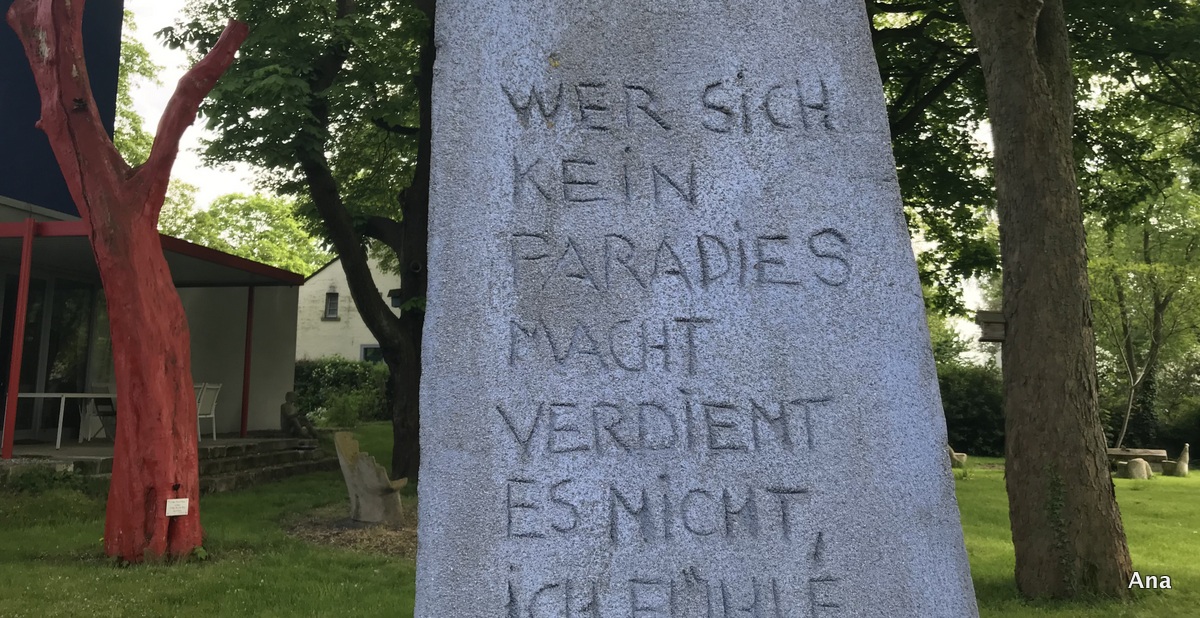
What impressed me yesterday: the fingernails of Ms. Giersberg. So colourful, so clunky and so … impractical? They are of the extra-long kind, glued on, with green and purple stripes with glitter. While Ms. Giersberg is awkwardly gathering the coins from the counter and hands us our tickets, I wonder why I associate ‚female‘ with impracticality.
Before we know it, we are in the middle of the tour. Our guide takes us through an old zinc factory, where the stuff—that stuff I had seen advertised just this morning on the back of my toothpaste for its disinfectant qualities—was produced around 1860 at the cost of many lives. “Electrolysis,” my chemist had told me on the phone earlier.
What we see here is way before electrolysis, pyrometallurgy is what they call it. Or, put in my own words: they cast super-heavy (as in 25kg-heavy), super-hot zinc plates, which were the end result after melting the whole shebang so that the raw zinc, originally made out of zinc ore, separated from the lead. I have forgotten what floated on top and what fell to the bottom of this infernal brew, but cadmium and arsenic—among other things—were also set free and inhaled in this process, and that stuck with me.
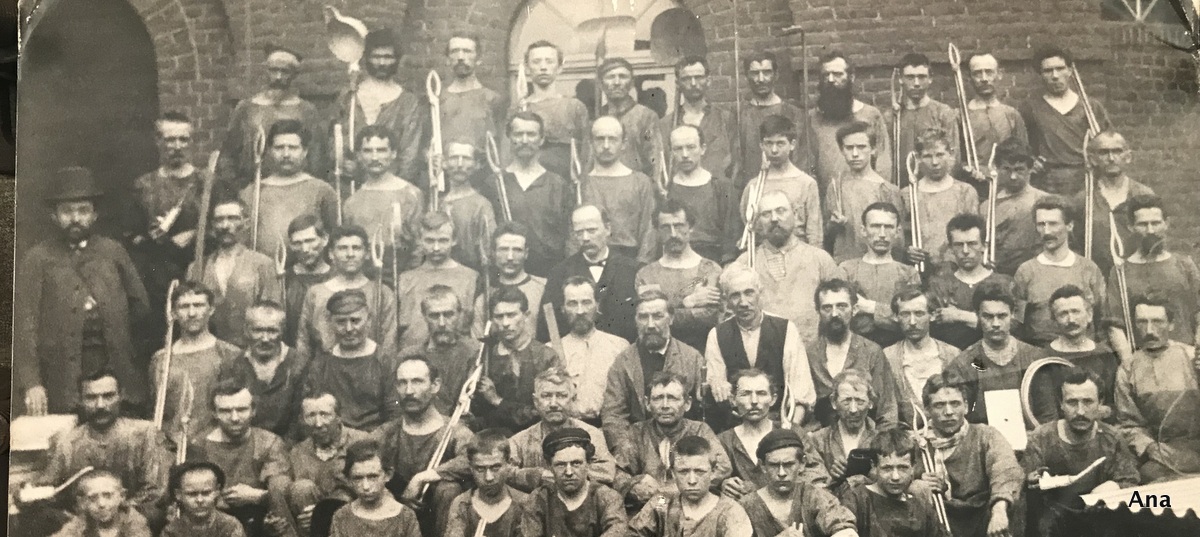
The usual shift was twelve hours. No, wait a moment, it was only six or eight hours long. That’s only because with the heat and all the hard work, people lost so much weight that it turned out to be more economical to shorten the shifts. The number of men prepared to do that kind of drudgery wasn’t limited, but it was advisable to keep them alive at least for a while. It didn’t pay off otherwise. And elephant-calluses—that’s what people got from working there—were cheaper than paying for heat-resistant gloves. The old age pension was only ever meant for the widow and the kids, but no one said that out loud. In one of the black-and-white photos displaying a group of old men, the youngest was fourteen and the oldest forty-five. Except, of course, the owner of the factory, he must have been a healthily glowing sixty.
Today, they do it hydrometallurgically, not pyro-; and the times are modern, and Ms. Giersberg can enjoy her fingernails.
On we go, continue with the coke, which they could only mine after they had invented the steam engine, otherwise the shafts would have kept flooding On we go, continue with the coke, which they could only mine after they had invented the steam engine; otherwise, the shafts would have kept flooding with water. Plus, coke burns at higher temperatures; this was actually the reason it was possible to make steel. I forgot when exactly in the process, but it is produced in a blast furnace – they say that because air is blasting through the hot liquid from below. Only then, because of or with a lot of flying sparks, the oxygen burns, then silicon and manganese, and later, with even higher temperatures, carbon and phosphorus. Then the tapping, slag on top, metal at the bottom. The slag goes to the scree and is still glowing red-hot.
My Grandma must have witnessed all this, during the forties and fifties. They lived in Duisburg in the Kochstrasse, the slag heaps around the corner. I heard the children’s version of the glowing heaps from her when I was little: When the sun goes down and the horizon is red, it means that the angels are making cookies for Christmas. That seemed logical to my five-year-old mind. There had to be a lot of cookie-baking for Christmas, and after all, this was what tin cans were for, to keep the cookies fresh. I was very happy though that we still also made our own cookies, especially when the Spritz-cookie-dough was put through the meat grinder with one of those zig-zag gauges. Minced meat came from the butcher by then; nobody did it by themselves anymore. I only remember one time; our neighbours killed a pig and the blood was collected in a bucket and we made black pudding from it.
I am distracted. Pig-iron is brittle and refractory because it still contains too much carbon, 4.5% or so. You are only allowed to call it steel with less than two per cent carbon. 0.2% is even better, that’s an S235 alloy if I remember correctly. We tested that in a universal testing machine for tensile strength. Bang!, the steel tore apart. The machine is fitted with a little motor that powers a hydraulic pump, which lifts (in millimeters) the trapped steel (in „μ“), thus ripping it. Atom by atom, the steel groaned. And the fingernails of Ms. Giersberg.
 meinbaumhaträder // mytreehaswheels